February 10, 2026
4 mins
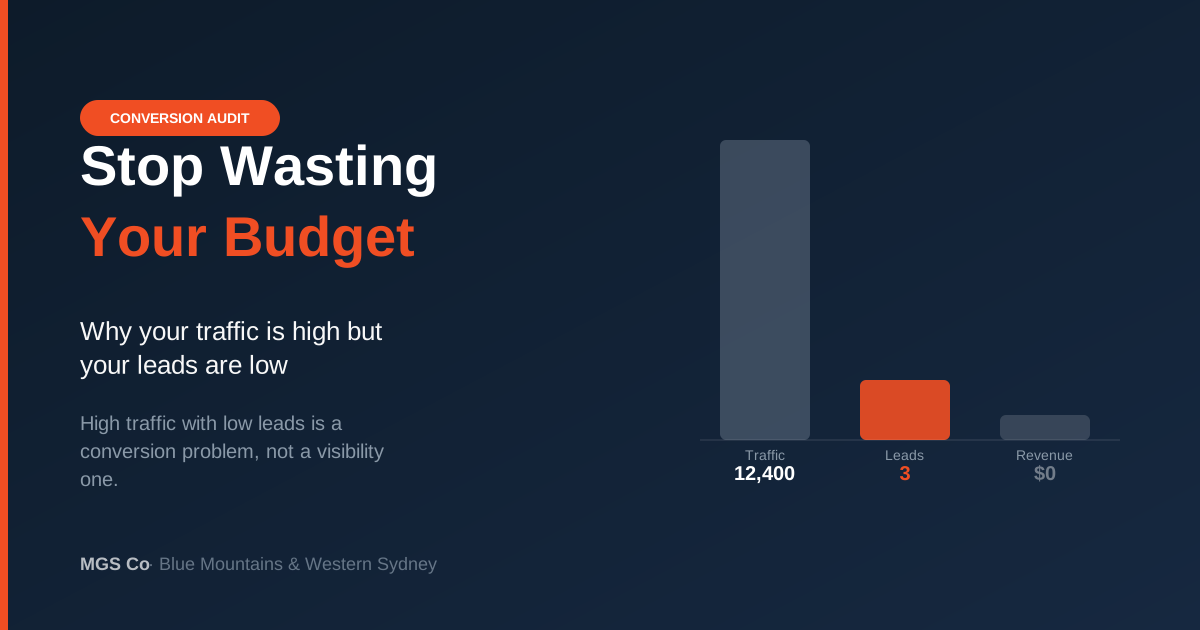
There is nothing more frustrating than watching your website traffic climb while your sales stay flat. If you're getting hundreds or thousands of visitors but no one is filling out your contact form or picking up the phone, you don't have a visibility problem — you have a conversion problem. Whether it's a mismatch in search intent, a cluttered website experience, or a lack of systems to capture leads when they arrive, ghost traffic is one of the biggest silent killers of marketing budgets. Before you spend another dollar driving more visitors, it's worth understanding whether the visitors you're already getting have any real reason to act.+
Not all traffic is equal. A visit from someone actively looking to hire your services is worth something. A visit from someone browsing, researching a topic for general interest, or looking for something adjacent to your offering costs the same to acquire and generates nothing in return.
The most common cause of high traffic and low leads is targeting too broadly. Campaigns optimised for maximum traffic volume will attract an audience that includes a significant proportion of people who will never become customers. The numbers look impressive in a report. The pipeline stays empty.
Diagnosing this requires looking beyond traffic volume to traffic quality. Which keywords are driving visitors? What is the average time they spend on the page? Which pages have high bounce rates? These signals tell you whether you're attracting buyers or browsers — and they're the starting point for every conversion audit we run.
Closely related to the wrong crowd problem is the intent gap — a mismatch between what your content is optimised for and what your actual buyers search when they're ready to act.
A common scenario: a service business builds a library of detailed educational blog posts explaining how to approach common problems in their trade. The content ranks well and drives consistent organic traffic. But the visitors reading those posts are people who want to solve the problem themselves — not hire someone. The traffic is technically relevant but commercially worthless.
Every piece of content on your website should be audited for commercial intent. Ask: who is searching for this, and are they the kind of person who would hire me? Educational content has its place in an SEO strategy — it builds authority and feeds GEO signals. But it should complement conversion-focused content, not replace it. If your highest-traffic pages are all informational and your buyer-intent pages are buried, your funnel has a fundamental structural problem.
Assuming you're attracting the right people, the next question is: what happens when they arrive? There are predictable points in every website where potential leads drop off — not because they weren't interested, but because something got in their way.
Contact forms that ask too many questions at the initial stage are one of the most common culprits. Every additional field reduces the number of people who complete the form. For most service businesses, name, phone number, and a brief description of what they need is enough to qualify a lead. Everything else can happen in the conversation.
An unclear or invisible phone number is another. Mobile visitors — who now represent the majority of local search traffic — need to find a clickable number within seconds of landing. If they have to scroll to find contact details, a meaningful percentage won't bother.
Weak or generic calls to action are the third. "Contact us" tells a visitor nothing about what they'll get or what happens next. "Get a free quote today" and "Book a free strategy call" set a clear expectation, remove uncertainty, and give the visitor a specific reason to act now rather than later. The difference in conversion rate between a vague prompt and a specific one is consistently significant.
Even when a potential customer fills out your contact form, the window to convert them is shorter than most businesses realise. Research consistently shows that the probability of qualifying a lead drops significantly within the first few hours of an enquiry. By the following day, many prospects have moved on — found another provider, lost momentum, or simply forgotten they reached out.
For most service businesses, this is a process problem rather than a marketing problem. The leads exist. The follow-up system doesn't.
Simple automation closes this gap reliably. An automated email or SMS that fires within minutes of a form submission confirms receipt, sets an expectation for when the prospect will hear from someone, and gives them a direct way to call if they'd prefer not to wait. It keeps the lead warm in the critical gap between their enquiry and your response.
More sophisticated automation can segment leads by service type, suburb, or job description and route them to the right person with the relevant context already surfaced. The result is faster response, fewer dropped leads, and a materially higher conversion rate from enquiry to booked job.
When we review a business's marketing and find the gap between traffic and leads, we work through a structured audit covering all of the above — traffic quality, intent alignment, on-page friction, and follow-up processes. The output is a prioritised list of changes ranked by their likely impact on lead volume.
Some fixes take an afternoon to implement. Others require more significant structural changes to content or page design. But in almost every audit we conduct, there are quick wins — issues that have been quietly costing the business leads for months, sometimes years, that can be addressed within a week.
The most consistent insight from this work: most businesses don't have a traffic volume problem. They have a marketing efficiency problem. More spend on driving visitors, before fixing the conversion gaps, simply means wasting a larger budget at a faster rate. Fix the funnel first. Then scale what works.
Book a free strategy session with MGS Co. We'll take you through our audit framework and show you exactly where the gap is — and what it would take to close it. No jargon, no generic recommendations. Just a clear, honest assessment of your current setup and the specific changes that will move the needle.
Book a 30-minute call with James. Straight talk about your market, your competitors, and where the low-hanging fruit sits.
Book a free strategy session