February 24, 2026
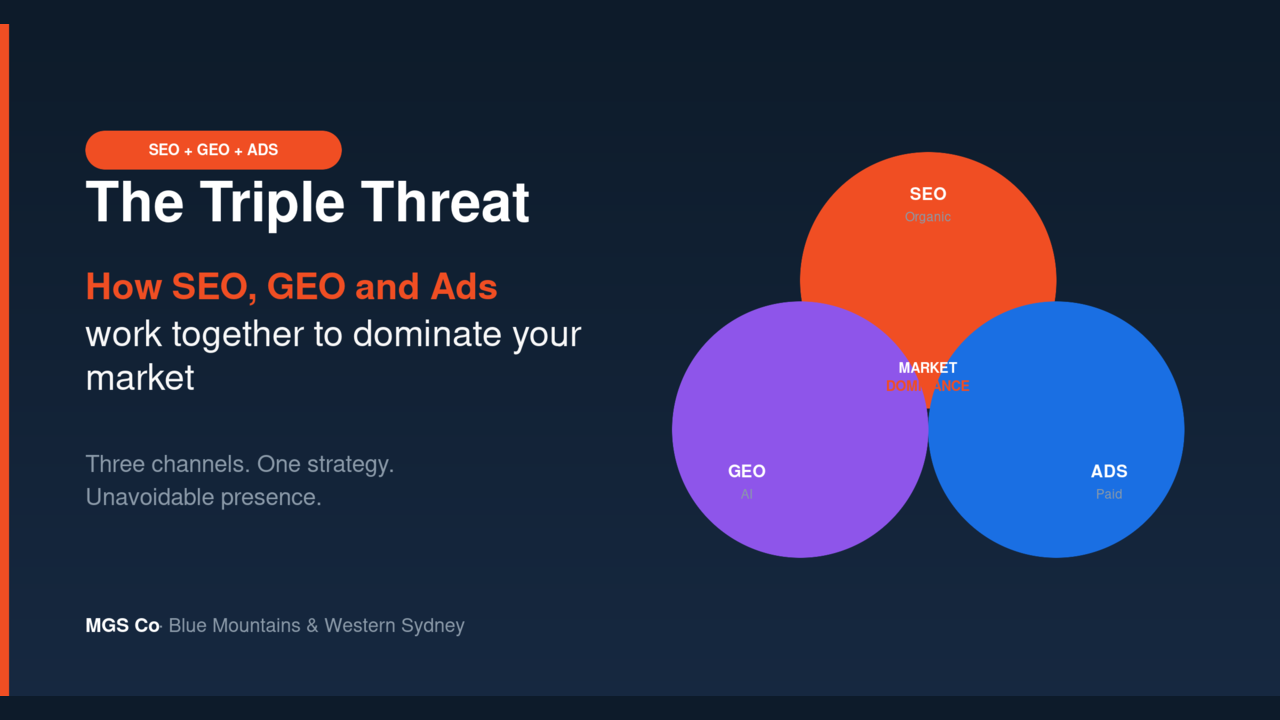
Many businesses — and frankly, many agencies — treat SEO, Google Ads, and AI search strategy as entirely separate activities. One team handles organic traffic, another handles paid, and nobody is thinking about what happens when a customer asks ChatGPT. This siloed approach wastes budget, misses compounding opportunities, and leaves entire channels unprotected. When your SEO data informs your ads, your ad performance shapes your content strategy, and your content feeds your GEO authority — you create a Triple Threat that makes your business effectively unavoidable. Here's how the integration works and why it changes the economics of your marketing.
When SEO, paid ads, and GEO are managed separately and without communication between them, the same mistakes tend to repeat across every channel. The same poor-performing landing pages appear in both organic rankings and paid campaigns. Keywords that ads prove convert well never get incorporated into the organic content strategy. Review management — critical for GEO — gets ignored because it doesn't belong cleanly to either the SEO team or the ads team.
Each channel also carries its own blind spot in isolation. A pure SEO strategy builds long-term traffic but has no mechanism for immediate lead generation. A pure ads strategy generates leads today but evaporates the moment you stop paying. A pure GEO strategy builds AI visibility but without SEO and ads foundations, it has limited commercial reach. The integration of all three removes these blind spots and turns each channel's data into fuel for the others.
One of the most underused advantages of running Google Ads alongside SEO is the speed of insight. Organic SEO takes months to generate statistically meaningful information about which keywords and messages convert. Google Ads can tell you within weeks.
A business running ads can test multiple messaging approaches — different value propositions, different urgency triggers, different local angles — and know within a month which one drives qualified enquiries. That winning message then becomes the foundation of the organic SEO content strategy. Instead of guessing what your customers respond to, you're using real conversion data to make that decision.
The reverse is equally valuable. Organic search data surfaces keywords that are already driving traffic to your site — keywords you might not have thought to bid on, or negative signals that tell you which broad match terms are consuming ad spend without converting. The two channels inform each other in real time.
Every service business needs both immediate leads and long-term security. Google Ads provides the first. SEO provides the second. Running them together means you're never entirely dependent on either.
In the early months of working with a client, ads typically carry the load. Organic rankings take time to build. Ads get your business in front of qualified buyers immediately, generating revenue while the SEO investment compounds in the background. As organic rankings improve, the dependency on aggressive ad spend decreases. You're generating leads from two channels simultaneously — paid traffic converting today, organic traffic growing month by month.
This is the moat. A competitor trying to enter your market faces the cost of matching both your organic authority and your paid presence at the same time. The combination is far harder to displace than either channel alone.
GEO sits above both SEO and ads in one important sense: it's about brand authority, not channel performance. When an AI model recommends your business, it's recognising your overall credibility — the combination of your content quality, your review reputation, your web presence, and your citation footprint.
This authority doesn't exist in a silo. A business with strong GEO signals — authoritative content, good reviews, consistent citations — will also perform better in organic search. Google's own algorithm increasingly weights the same signals that AI models use. The work you do for GEO reinforces your SEO. The reverse is also true: strong SEO — high-quality content, good technical structure, credible links — builds the web presence that AI models draw on when forming recommendations.
SEO and GEO are not competing strategies. They share the same foundations and compound each other's effectiveness. Adding both to a paid ads strategy creates a system where every marketing dollar works harder than it would in any single channel.
The most powerful argument for the Triple Threat approach is what happens to unit economics over time. In the short term, running three channels simultaneously requires more initial investment than running one. But the compounding dynamics change the picture fundamentally within twelve to eighteen months.
Ads improve as performance data accumulates. The same budget delivers more leads as you cut waste and concentrate spend on what works. SEO traffic grows without additional spend — a page that ranks generates leads month after month at effectively zero marginal cost. GEO authority, once established, is self-reinforcing: more reviews and citations produce stronger recommendations, which drive more business, which generate more reviews.
A business that runs all three consistently will typically find its cost per lead falling, not rising — because the channels are reinforcing each other rather than operating in isolation.
The practical advantage of the integrated approach is simplicity. Instead of managing separate agencies for SEO, ads, and content — each with their own metrics, their own reports, and their own blind spots — you have a single team that sees the whole picture.
Every month, one report covers organic traffic, ad performance, lead volume across channels, and the content and GEO activity driving long-term authority. You can see exactly how each channel is performing, how they're influencing each other, and where the next investment should go.
This is how we work at MGS Co — not as a sales proposition, but because it's the only approach we've seen consistently deliver sustainable growth for service businesses in competitive local markets.
Book a free strategy session with MGS Co. We'll assess where you're currently positioned across SEO, paid ads, and AI search, identify the gaps, and build a roadmap that makes your business impossible to miss.
Book a 30-minute call with James. Straight talk about your market, your competitors, and where the low-hanging fruit sits.
Book a free strategy session