March 1, 2026
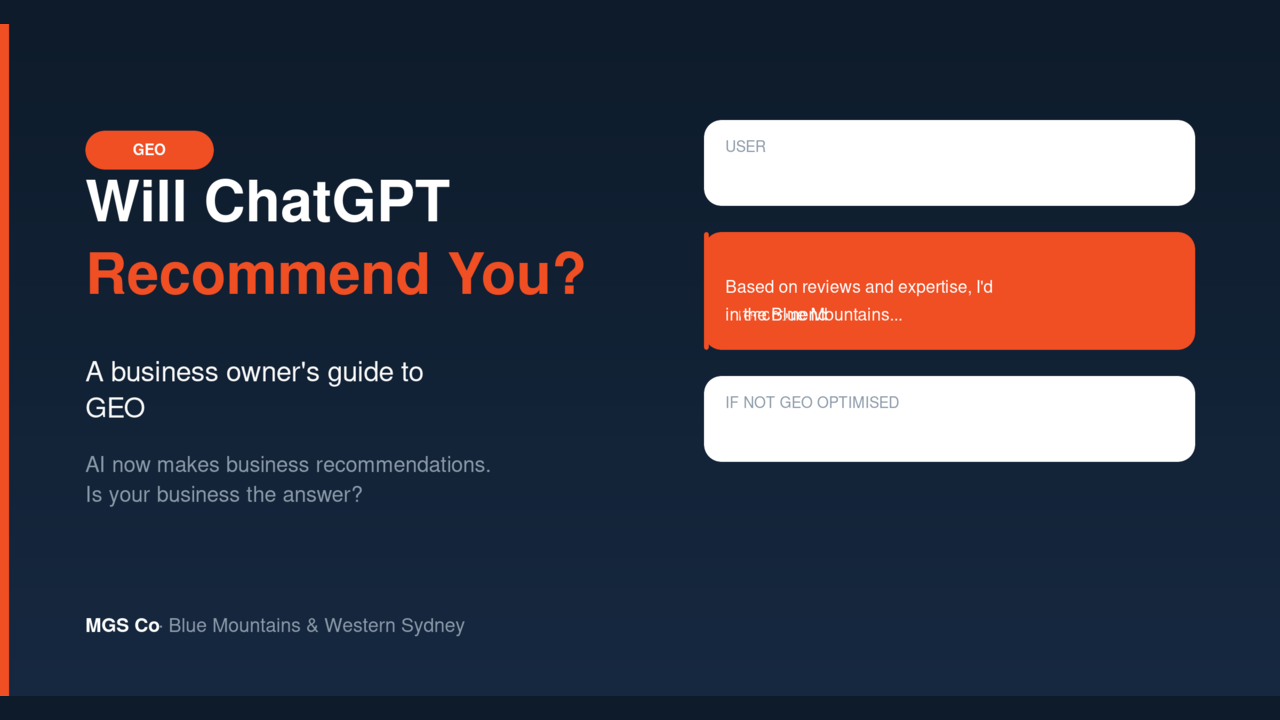
Think about how you research things today. Instead of opening ten browser tabs, you might just ask an AI: "Who's the most reliable tradie in the Blue Mountains?" or "Compare the top three real estate agencies near me." When that question is asked, does the AI mention your business? This is the core of Generative Engine Optimisation — GEO. It's not about tricking an algorithm. It's about establishing your brand's authority so clearly that AI models view you as the correct answer for your customers.
Generative Engine Optimisation is the discipline of ensuring your business appears in the recommendations made by AI-powered search platforms — tools like ChatGPT, Google's AI Overviews, Perplexity, and Gemini. Where traditional SEO focuses on ranking in Google's list of links, GEO focuses on becoming the answer an AI gives when someone asks a relevant question.
The distinction matters because AI doesn't serve a list of ten options and let the user choose. It synthesises available information and makes a recommendation. It says: "For that kind of service in that area, you should look at these businesses." Being on that shortlist is the new first page.
The challenge — and the significant opportunity — is that most businesses haven't started thinking about this yet. The ones that do, and build genuine AI visibility now, will hold a structural advantage over competitors who start later.
Large language models — the technology behind ChatGPT and Gemini — are trained on enormous volumes of publicly available text. When someone asks for a business recommendation, the AI draws on everything it has absorbed: reviews, website content, news articles, directory listings, social media, forum discussions, and industry mentions.
This is fundamentally different from Google's algorithm, which primarily ranks based on backlinks and keyword relevance. AI models are forming something closer to an informed opinion — a synthesis of all available information about your business, your reputation, and your demonstrated expertise.
The key signals that feed into that synthesis are: how clearly and authoritatively your website explains what you do, who you serve, and why you're good at it; the volume, recency, and sentiment of your online reviews; citations and mentions across credible directories, local publications, and industry platforms; and the consistency of your business name, address, phone number, and service descriptions across every online presence you maintain. Inconsistency creates confusion and actively dilutes your signal.
The old SEO playbook was largely about what you said about yourself — your website copy, your keywords, your meta descriptions. GEO introduces a critical shift: what others say about you now carries enormous weight.
Reviews are the most accessible lever. An AI processing a question about "who to hire for X in the Blue Mountains" will factor in the volume and quality of reviews for businesses in that category. A business with 80 recent, detailed reviews describing specific outcomes — the job done, the location, the result — will feature far more prominently than one with a dozen generic "great service!" ratings.
Encouraging your customers to leave detailed, specific reviews isn't just good for reputation. It's a direct GEO action. It's free, it's scalable, and it feeds exactly the kind of signal AI models are built to weigh.
Citations — mentions of your business in local directories, industry publications, local news, and community platforms — perform a similar function. Each one adds to the weight of evidence that your business is real, established, and respected in your market.
Traditional SEO content was often built around keyword density. You identified what people searched for, and you wrote content that contained those phrases. The result was often content that satisfied an algorithm but felt mechanical to a human reader.
GEO demands a different approach. AI models don't just pattern-match keywords — they assess whether your content genuinely answers the questions people ask. A blog post that thoroughly explains "how to choose an Bricklayer in Western Sydney" — covering what to look for, what questions to ask, what red flags to avoid — will signal authority far more effectively than a page stuffed with the phrase "Bricklayer Western Sydney."
This is genuinely good news for businesses willing to invest in quality content. The shift rewards expertise, honesty, and depth over keyword manipulation. Write for the person asking the question, not for the algorithm counting the words.
AI search is not a future trend. It's a current reality that is expanding rapidly. Google has integrated AI Overviews into standard search results. ChatGPT continues to grow. New AI search tools are launching regularly. The direction of travel is unambiguous.
The businesses that build GEO authority in 2026 will hold a compounding advantage. AI models learn from the web as it exists today. A business with strong reviews, authoritative content, and consistent citations built over the next twelve months will be far better positioned than one starting from zero in 2027.
For service businesses in Western Sydney and the Blue Mountains, the competitive landscape for AI recommendations is still relatively open. Most local businesses haven't started optimising for it. That window won't stay open indefinitely — and the businesses that move first will be the hardest to displace once they're established.
Book a free strategy session with MGS Co. We'll audit your current AI visibility, identify what's working and what's missing, and show you the specific steps that will get your business into the conversation.
Book a 30-minute call with James. Straight talk about your market, your competitors, and where the low-hanging fruit sits.
Book a free strategy session